
 Dear Rob:
I’ve been shopping for floors lately, and I’m very intrigued by the bamboo flooring products I’ve seen. Can you tell me a little bit about bamboo flooring and the differences between different bamboo flooring products?
-Jeff in Wisconsin
Dear Jeff:
Bamboo flooring has remained popular since manufacturers first introduced it to the flooring market.
Its versatile style and consistent look have made it a very popular flooring choice.
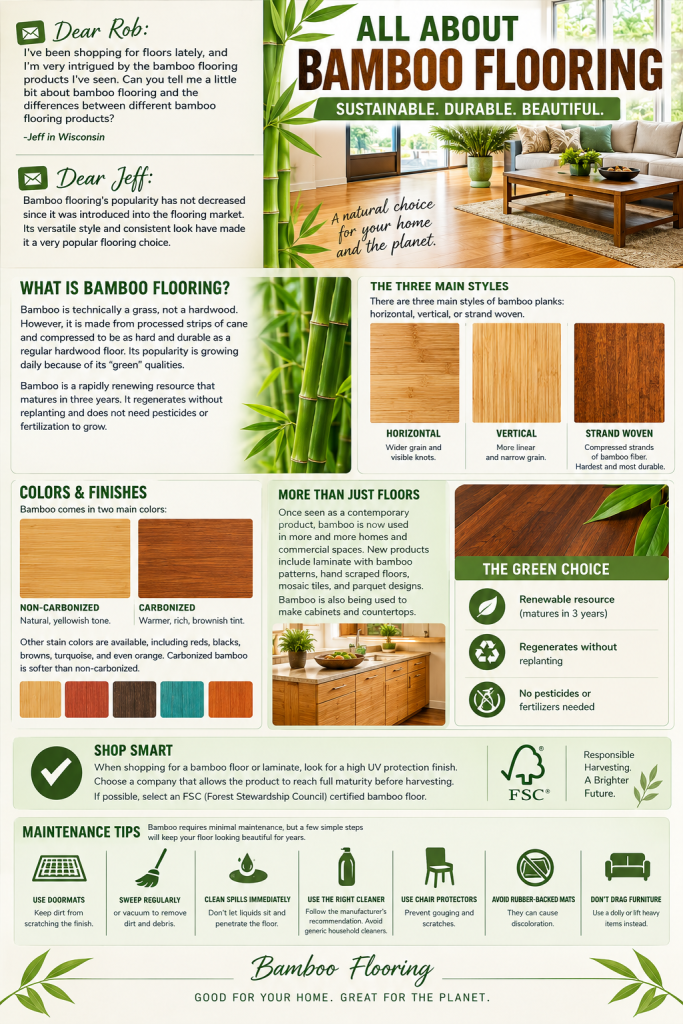
 Bamboo is technically a grass and not a hardwood. However, manufacturers process and compress strips of bamboo cane to create flooring that is as hard and durable as traditional hardwood.
It’s gaining popularity daily because of its “green” qualities. Bamboo is a rapidly renewing resource that matures in three years. Other green qualities include the fact that it regenerates without replanting and does not need pesticides or fertilization to grow.
There are three main styles of bamboo planks: horizontal, vertical, or strand woven.
With vertical bamboo flooring, the grain looks more linear and narrow, whereas with horizontal bamboo flooring the grain is wider and the knots of the bamboo are seen more prevalently. Strand woven bamboo, which consists of compressed strands of bamboo fiber, is the hardest and most durable bamboo flooring choice. Within the different bamboo styles, there are two main colors: carbonized and non-carbonized. Non-carbonized bamboo has a yellowish natural coloring, whereas carbonized has a warmer, rich, and brownish tint to it. Because of the growing demand for bamboo, other stain colors are available, such as reds, blacks, browns, turquoise, and even orange, but carbonized and non-carbonized are the two main colors you will see. One thing to keep in mind is that the carbonized product is softer than the non-carbonized.
Once considered a contemporary and modern product primarily, bamboo now appears in a growing number of residential and commercial applications. Manufacturers offer bamboo-patterned laminate for busy lifestyles and hand-scraped bamboo floors for more rustic and traditional designs. They also produce mosaic tiles and parquet patterns as alternatives to standard plank flooring. Bamboo is not just for floors anymore—manufacturers also use it to make cabinets and countertops.
Shopping
 When shopping for a bamboo floor or bamboo laminate floor, you want a floor that has a finish with a high UV protection content. You also want to support a company that lets the product reach full maturity before being harvested. If possible, try to select an FSC (Forest Stewardship Council) certified bamboo floor. This ensures that your floor was harvested properly.
Like hardwood, bamboo requires minimal maintenance. Place doormats at every entrance to keep dirt from scratching the floor’s finish. Sweep or vacuum regularly to remove dirt and debris. Clean up spills immediately so liquids do not sit and penetrate the floor. For prefinished bamboo flooring, use the cleaner recommended by the manufacturer. For unfinished flooring, use a hardwood-specific cleaning solution instead of a generic household cleaner.
Using the wrong type of cleaner can permanently damage the finish on the floor.
Place chair protectors on the bottoms of all chairs to prevent gouges. Avoid rubber-backed mats because they can discolor the floor. Lift furniture and other heavy objects instead of dragging them across the floor.
These simple steps will keep your floor beautiful and long-lasting.
-Rob
Hi Rob,
Nice article on bamboo flooring , in india i have seen bamboo furniture maybe you could add that as a bonus “matching decor”..just a thought.
Deepak-
Send me an email through the contact form. I would love to chat with you.
I’ve had a glue down carpet on a wood sub floor for ten years…what kind of prep is going to be necessary to place a bamboo floor?
There is not enough space. Tell you what, submit it through the form above, and I will email you the answer, and post it tomorrow, OK?
Great timing, Rob. We’re getting ready to redo our floors and I have been seriously considering bamboo. How does it hold up against dog and cat claws?
I love the bamboo flooring that you talk about above. I have been considering putting it in my salon and it sounds like it would work perfectly. Thanks for the helpful and informative information!
Charlie-
Keep me updated on how it goes. Like any species of wood, keep dog claws trimmed. You may want a harder variety like strand woven.
Commercial Cleaner-
Great! I hope your floors turn out well.