
 Installing a solid hardwood floor in the home or at the office can make the place feel warm and look beautiful. However, such flooring is not appropriate for every level of the home or office. Learning what grade level is best for hardwood flooring will help keep customers happy and allow installers and contractors to best advise their clients on their flooring options at every level.
About Hardwood Flooring
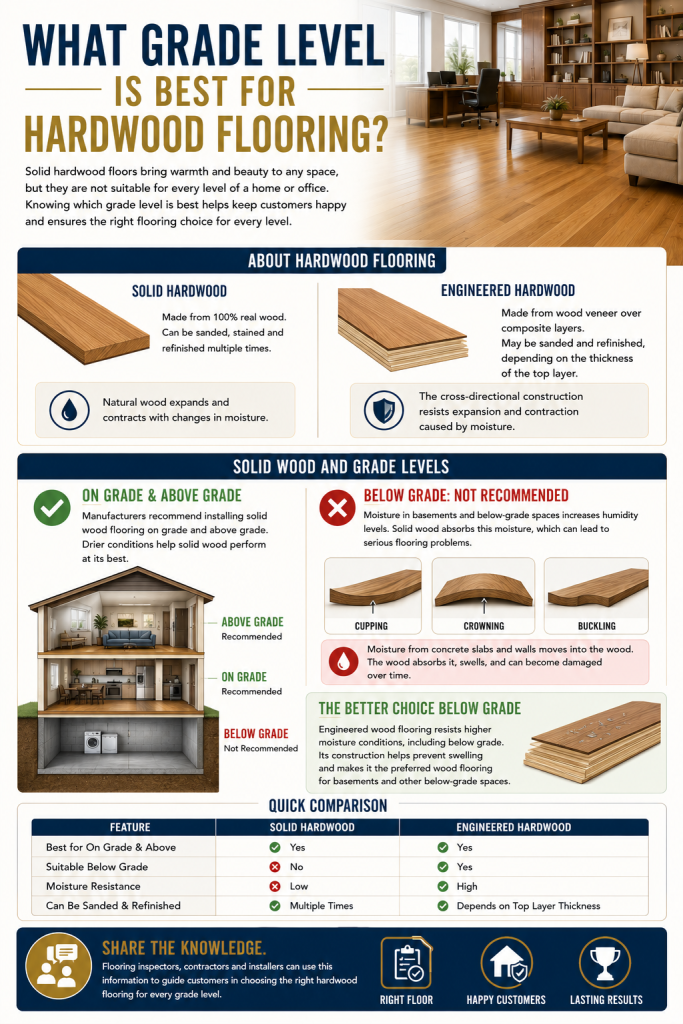
There are two types of wood flooring, solid and engineered. Manufacturers create solid wood flooring from complete pieces of natural wood. Homeowners and flooring professionals can sand, stain, and refinish solid wood flooring multiple times throughout its lifespan.
Because they are natural pieces of wood, the material expands and contracts with too much moisture.
Engineered wood, on the other hand, is comprised of wood composite veneer.
Depending on how manufacturers construct the material, engineered wood flooring may allow sanding and refinishing during its lifetime. The ability to refinish the flooring usually depends on the thickness of the top wear layer.
Manufacturers build engineered wood with wood grains running in different directions throughout the layers. This cross-layer construction helps the flooring resist expansion and contraction caused by moisture changes. As a result, engineered wood flooring is generally more stable than solid wood flooring in areas with higher humidity or moisture exposure.
Solid Wood and Grade Levels
Manufacturers of solid wood flooring recommend installing solid wood on grade or above grade. Most manufacturers do not recommend installing solid wood flooring below grade.
Below-grade areas, such as basements, often contain higher levels of moisture and humidity. Moisture can move through concrete slabs and foundation walls and increase the humidity in the space. These conditions can create problems for solid wood flooring over time. Solid wood floors will be at their best on grade and above grade due to the drier conditions.
If solid wood flooring is installed below grade, the wood will absorb the extra moisture that comes in through the concrete slabs and walls. When solid wood absorbs moisture, the material can swell up, causing cupping, crowning, and even buckling.
The good news is that engineered wood flooring has a much better resistance to higher moisture conditions, such as below-grade conditions. The way that it is manufactured helps it to resist swelling from higher moisture conditions. Because it is better able to resist expansion, engineered flooring is the preferred wood flooring for below-grade spaces.
Flooring inspectors, contractors, and installers can share this valuable information with their customers and clients so they can better choose and install the proper flooring that can appear on each grade level.
[…] installing a wood floor, the installation team should acclimate the planks or store them in the room they will be installed in for a few […]