Flooristics, LLC

Article Search

Family Owned, Locally Operated
  • Home
  • Blog
    • Videos
    • Podcasts
    • Carpet and Rugs
    • Expert Witness
    • Floor Safety
    • Flooring Help
    • Hardwood and Laminate
    • Podcasts
    • Resilient
    • Tile and Stone
    • Tools
  • About
  • Contact
  • Floor Inspections
  • Expert Witness Services
  • Walkway Audits
    • Walkway Audit Process
    • OSHA “Qualified Person”

Approved Underlayment and Subfloor Materials for Vinyl

January 13, 2017 by Flooristics staff Leave a Comment

Share Button

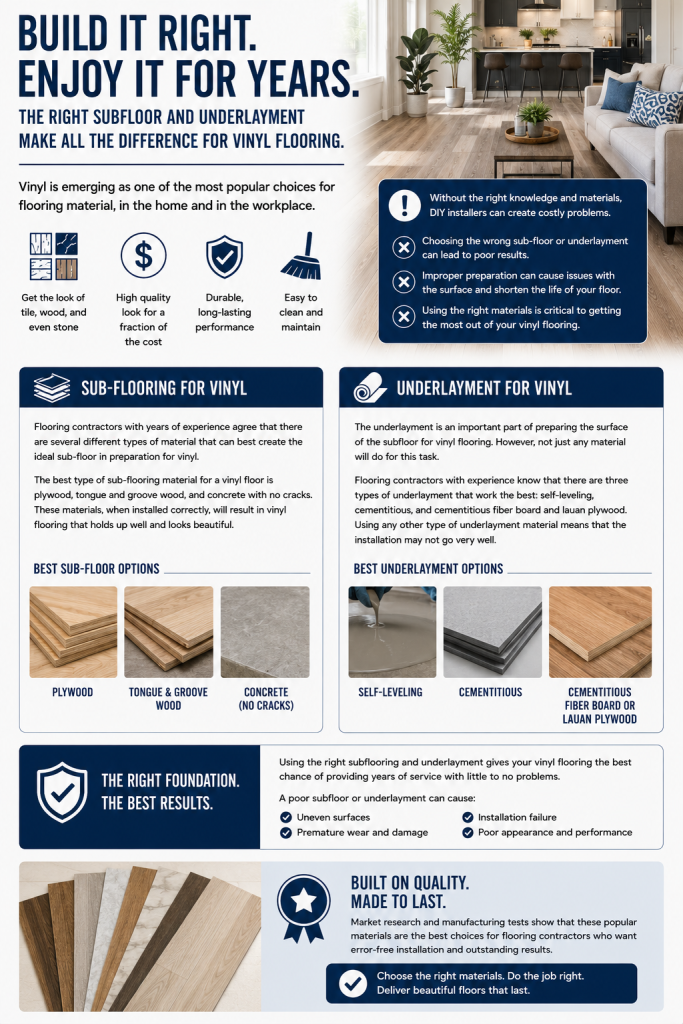
Vinyl is emerging as one of the most popular choices for flooring material in the home and in the workplace. What was once viewed as cheap and low-budget now brings amazing textures, styles, and patterns to the marketplace.

Customers can get the appearance of tile, wood, and even stone with high-quality vinyl flooring. Vinyl provides these looks at a fraction of the cost of natural materials. It is also much easier to clean and maintain.

Many people do not realize how much preparation goes into installing vinyl flooring properly. Without experience or training, homeowners and business owners may overlook important steps in preparing the subfloor. Choosing the wrong subfloor or underlayment material can create unnecessary surface problems and lead to poor installation results.

Using the correct materials is critical for long-term appearance and performance. Proper subfloor and underlayment preparation helps vinyl flooring remain durable, stable, and attractive over time.

Sub-flooring for Vinyl

Experienced flooring contractors understand that the right subfloor material plays an important role in vinyl flooring installation. Several types of materials can help create a stable and durable surface for vinyl flooring.

Many flooring experts recommend plywood, tongue-and-groove wood, and crack-free concrete as the best subfloor materials for vinyl flooring. These materials provide a stable surface and help support long-term flooring performance. These materials, when installed correctly, will result in vinyl flooring that holds up well and looks beautiful.

Underlayment for Vinyl

The underlayment is an important part of preparing the surface of the subfloor for vinyl flooring. However, not just any material will do for this task. Flooring contractors with experience know that three types of underlayment work the best: Self-leveling, cementitious, and cementitious fiber board, and lauan plywood. Using any other type of underlayment material means that the installation may not go very well.

If flooring contractors rely on these materials for the subflooring and the underlayment, their vinyl flooring job will have the best chance of providing the customer with years of service and little to no problems. There’s a reason why vinyl is becoming a true favorite for customers who want durability and beauty, but a subpar subfloor or underlayment can significantly affect appearance and performance.

While there are many different materials that can be used as subfloor and underlayment for vinyl, market research and manufacturing tests show that these popular materials are the best choices for flooring contractors who want error-free installation and outstanding results.
Filed Under: Expert Witness, Floor Safety, Flooring Help, Resilient Tagged With: preparing for vinyl, vinyl floor, vinyl flooring tips, vinyl floors, vinyl sub-floor, vinyl subfloor, vinyl underlayment

Leave a Reply Cancel reply

Your email address will not be published. Required fields are marked *

Call Today! 1.801.574.0387

  • Email
  • Facebook
  • Pinterest
  • RSS
  • Twitter
  • YouTube

Recent Posts

Oklahoma City Slip and Fall Expert Witnesses Uncover Evidence

Business owners in Oklahoma City may be facing one or more liability lawsuit if their employee or a … [Read More...]

How Do Mold and Mildew Get Under Vinyl Flooring?

Vinyl flooring is a popular choice for high-traffic areas at home and in the workplace. Many people … [Read More...]

Recent Comments

  • Approved Underlayment and Subfloor Materials for Vinyl - Flooristics, LLC on What Surface Is More Resistant to Scuffing?
  • What is a Vinyl Printing Defect? - Flooristics, LLC on What Causes Hard Surface Floors to Turn Yellow
  • Causes and Solutions for Vinyl Seam Failure - Flooristics, LLC on Certified Floor Inspections

Contact Us

Flooristics, LLC
P.O. Box 91171
Salt Lake City, UT 84109
801.574.0387

View our Financial Disclosure. and Privacy Policy.
© 2014 Flooristics, LLC. All rights reserved.