Flooristics, LLC

Article Search

Family Owned, Locally Operated
  • Home
  • Blog
    • Videos
    • Podcasts
    • Carpet and Rugs
    • Expert Witness
    • Floor Safety
    • Flooring Help
    • Hardwood and Laminate
    • Podcasts
    • Resilient
    • Tile and Stone
    • Tools
  • About
  • Contact
  • Floor Inspections
  • Expert Witness Services
  • Walkway Audits
    • Walkway Audit Process
    • OSHA “Qualified Person”

What is Polypropylene (Olefin)?

July 12, 2017 by Flooristics staff 3 Comments

Share Button

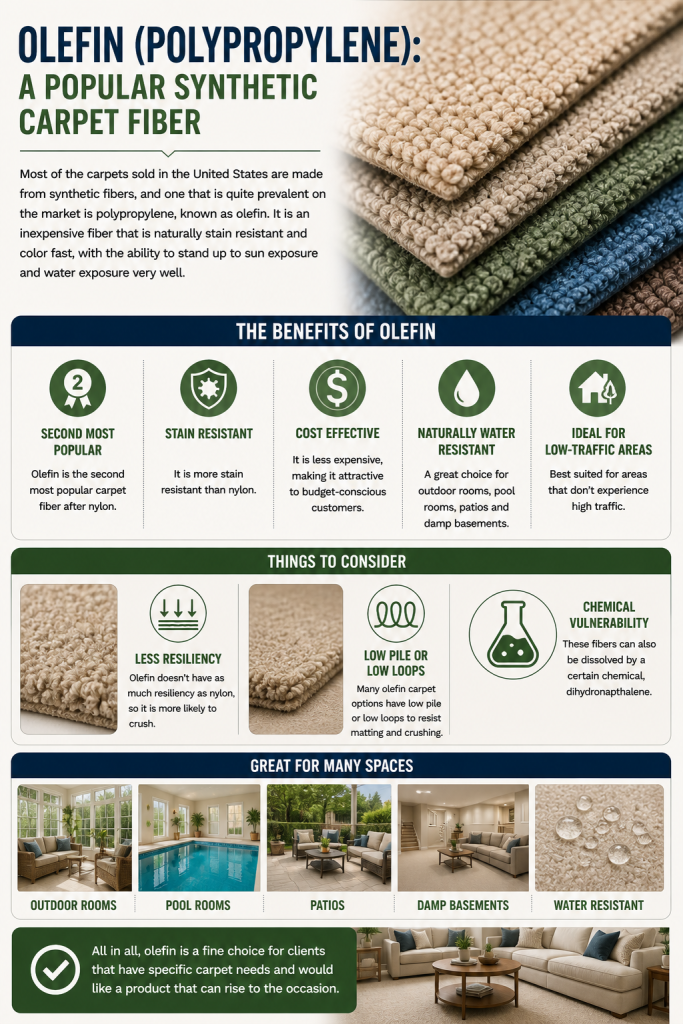
Manufacturers make most carpets sold in the United States from synthetic fibers, and polypropylene, known as olefin, is one of the most prevalent options on the market. It is an inexpensive fiber that is naturally stain resistant and color-fast, with the ability to stand up to sun exposure and water exposure very well.

Olefin is the second most popular carpet fiber after nylon. It isn’t quite as durable as nylon, but it is more stain resistant and less expensive. This makes it attractive to certain clients. These clients want a flooring product for areas with low traffic. Olefin offers many benefits. It is naturally water-resistant. This makes it a good choice for outdoor rooms, pool rooms, patios, and damp basements.

Because this synthetic fiber doesn’t have as much resiliency as nylon, it is more likely to crush. Manufacturers make many olefin carpet options as low-pile or low-loop styles. This makes it difficult for the carpet to become matted or crushed. These fibers can also be dissolved by a certain chemical, dihydronaphthalene.

All in all, olefin is a fine choice for clients who have specific carpet needs and would like a product that can rise to the occasion.
Filed Under: Carpet and Rugs Tagged With: carpet fibers, olefin, olefin carpet, polypropylene carpet, polypropylene olefin, synthetic carpet fiber

Trackbacks

  1. Stain Resistant Technology for Carpets - Flooristics, LLC says:
    April 18, 2026 at 12:39 pm

    […] into the fibers, making a stain. Synthetic fibers often naturally resist staining, such as olefin or polyester. Other common carpet fibers, like wool or nylon, are more likely to stain unless they […]

    Reply
  2. Dyeing Carpet for Color Retention - Flooristics, LLC says:
    April 18, 2026 at 1:05 pm

    […] continuous dyeing. However, solution dyeing remains one of the most preferred. In solution dyeing, synthetic yarn is extruded, and the filaments are saturated with dye. This process makes solution-dyed carpet one […]

    Reply
  3. How to Detect Urine in the Carpet - Flooristics, LLC says:
    April 21, 2026 at 1:04 pm

    […] it comes to cleaning up urine, there are a few options, such as a vinegar solution, commercial enzyme cleaner, and more. With the […]

    Reply

Leave a Reply Cancel reply

Your email address will not be published. Required fields are marked *

Call Today! 1.801.574.0387

  • Email
  • Facebook
  • Pinterest
  • RSS
  • Twitter
  • YouTube

Recent Posts

Advantages of Ceramic and Natural Stone Tile

Dear Rob: I've read all about different ways to use tile and hardwood on your site, and I'm still … [Read More...]

Idaho Laminate Flooring Inspectors Are Worth It

As a business owner, you want to create an inviting, attractive and professional-looking workplace … [Read More...]

Recent Comments

  • Common Flooring Mistakes By Maintenance Workers - Flooristics, LLC on Certified Floor Inspections
  • How Can Moisture Problems in Concrete be Corrected? - Flooristics, LLC on Certified Floor Inspections
  • What Causes Crowning and Cupping in Wood Floors? - Flooristics, LLC on Certified Floor Inspections

Contact Us

Flooristics, LLC
P.O. Box 91171
Salt Lake City, UT 84109
801.574.0387

View our Financial Disclosure. and Privacy Policy.
© 2014 Flooristics, LLC. All rights reserved.