Flooristics, LLC

Article Search

Family Owned, Locally Operated
  • Home
  • Blog
    • Videos
    • Podcasts
    • Carpet and Rugs
    • Expert Witness
    • Floor Safety
    • Flooring Help
    • Hardwood and Laminate
    • Podcasts
    • Resilient
    • Tile and Stone
    • Tools
  • About
  • Contact
  • Floor Inspections
  • Expert Witness Services
  • Walkway Audits
    • Walkway Audit Process
    • OSHA “Qualified Person”

What Causes Grout to Break Up?

September 24, 2016 by Flooristics staff 4 Comments

Share Button

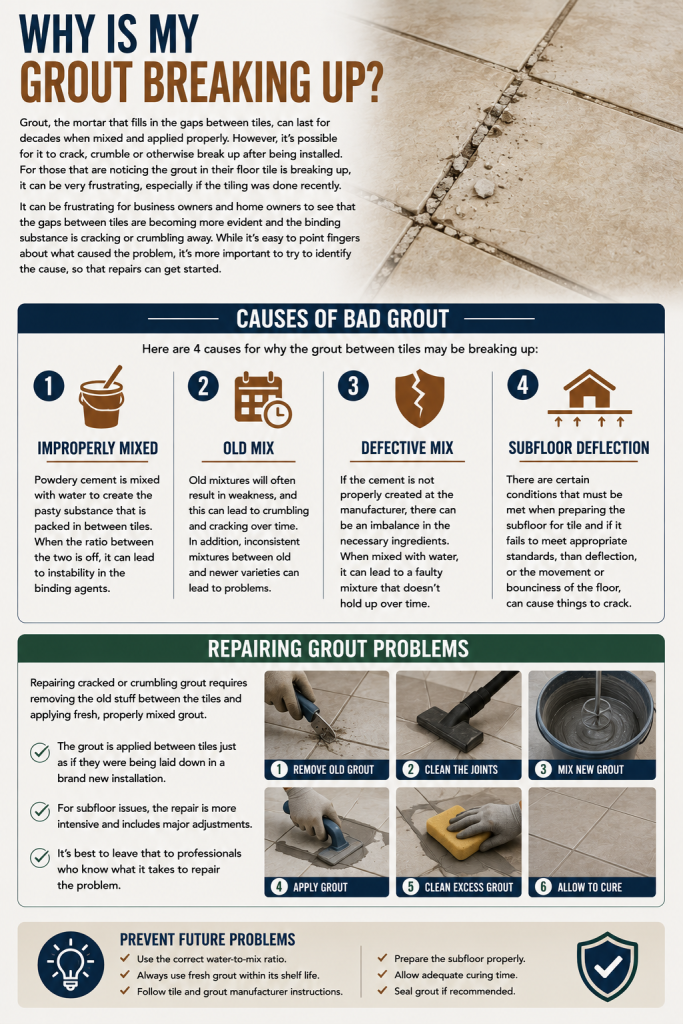
groutGrout, the mortar that fills in the gaps between tiles, can last for decades when mixed and applied properly. However, it can crack, crumble, or otherwise break up after being installed.

Homeowners and business owners can become very frustrated when grout starts breaking apart in a tile floor. The problem can feel even more disappointing when installers completed the tile installation only recently.

As grout cracks or crumbles, the gaps between the tiles become more noticeable. The floor may begin to look worn, damaged, or poorly maintained. Loose or deteriorating grout can also raise concerns about the long-term durability and stability of the tile installation.

While it’s easy to point fingers about what caused the problem, it’s more important to try to identify the cause, so that repairs can get started.

Causes of Bad Grout

Here are 4 causes for why the grout between tiles may be breaking up:

  1. Improperly mixed: Installers mix powdered cement with water to create the paste placed between tiles. If installers use the wrong ratio of water to cement, the grout mixture can become unstable and weaken the binding agents.
  2. Old mix: Old mixtures will often result in weakness, and this can lead to crumbling and cracking over time. In addition, inconsistent mixtures between old and newer varieties can lead to problems.
  3. Defective mix: Manufacturing errors can create an imbalance in the ingredients used to make the cement. When installers mix the defective cement with water, the grout mixture may weaken and fail over time.
  4. Subfloor deflection: Installers must meet certain conditions and standards when preparing a subfloor for tile installation. If the subfloor does not meet those standards, floor deflection, movement, or excessive bounce can cause grout and tile to crack over time.

Repairing Grout Problems

Repairing cracked or crumbling grout requires removing the old stuff between the tiles and applying fresh, properly mixed grout. The grout is applied between tiles just as if they were being laid down in a brand new installation. For subfloor issues, the repair is more intensive and includes major adjustments. It’s best to leave that to professionals who know what it takes to repair the problem.


Filed Under: Floor Safety, Flooring Help, Tile and Stone Tagged With: cracked grout, crubling group, Grout, grout trouble, preparing grout, problematic grout, subfloor deflection

Comments

  1. Don says

    June 27, 2023 at 2:27 pm

    When I tap on the floor tiles with a broomstick some of them sound hollow, and there’s grout coming out all over the place. What’s up with that?

    Reply

Trackbacks

  1. Laying Tile in Rooms That Are Not Square - Flooristics, LLC says:
    April 27, 2026 at 9:18 pm

    […] frustrating aspects of a tile job occurs when a room is not square. This can create a number of issues with tile placement that can really affect the appearance of the final […]

    Reply
  2. Ceramic Tile, Why Should Installers Mix Tile Boxes? - Flooristics, LLC says:
    April 29, 2026 at 11:01 am

    […] they might install one entire box on one side and then place another full box next to it. The mismatches would be very obvious. By mixing the tiles, any mismatches will not be apparent because the variations are spread all […]

    Reply
  3. Best Subfloors and Underlayment for Ceramic Tile Flooristics, LLC says:
    May 17, 2026 at 1:14 pm

    […] While many flooring contractors may have a preference for different materials for underlayment and sub-floors depending on the location, climate, and cost, most experts agree that there are certain materials that are the best when it comes to supporting a top-quality ceramic tile floor. […]

    Reply

Leave a Reply Cancel reply

Your email address will not be published. Required fields are marked *

Call Today! 1.801.574.0387

  • Email
  • Facebook
  • Pinterest
  • RSS
  • Twitter
  • YouTube

Recent Posts

What are Primary and Secondary Backing in Carpet?

Wondering about primary and secondary backing in carpeting? When it comes to carpeting, there are … [Read More...]

Episode 1: Claudia Lezell on Floor Industry Standards

In This Episode Learn About the Importance of Floor Industry Standards Rob McNealy interviews, … [Read More...]

Recent Comments

  • Common Flooring Mistakes By Maintenance Workers - Flooristics, LLC on Certified Floor Inspections
  • How Can Moisture Problems in Concrete be Corrected? - Flooristics, LLC on Certified Floor Inspections
  • What Causes Crowning and Cupping in Wood Floors? - Flooristics, LLC on Certified Floor Inspections

Contact Us

Flooristics, LLC
P.O. Box 91171
Salt Lake City, UT 84109
801.574.0387

View our Financial Disclosure. and Privacy Policy.
© 2014 Flooristics, LLC. All rights reserved.