
 Dear Rob, I have three very large dogs and two kids. I was told not to put in hardwood floors because they will get scratched, but if I did, I should go with a really hard wood. How do I know how hard a wood is?
-Darlene D. from Oklahoma City, Oklahoma
Dear Darlene:
With three dogs and two kids, your floors will certainly take some abuse, but you can minimize the damage and extend the life of your floor with a harder wood. The harder a wood is, the less susceptible to denting and scratches it will be. Although more expensive than oak, many of the South American hardwoods like Brazilian Cherry (Jatoba), Brazilian Teak (Cumaru), and Brazilian Walnut (Ipe) are incredibly hard woods and would certainly hold up better to your lifestyle.
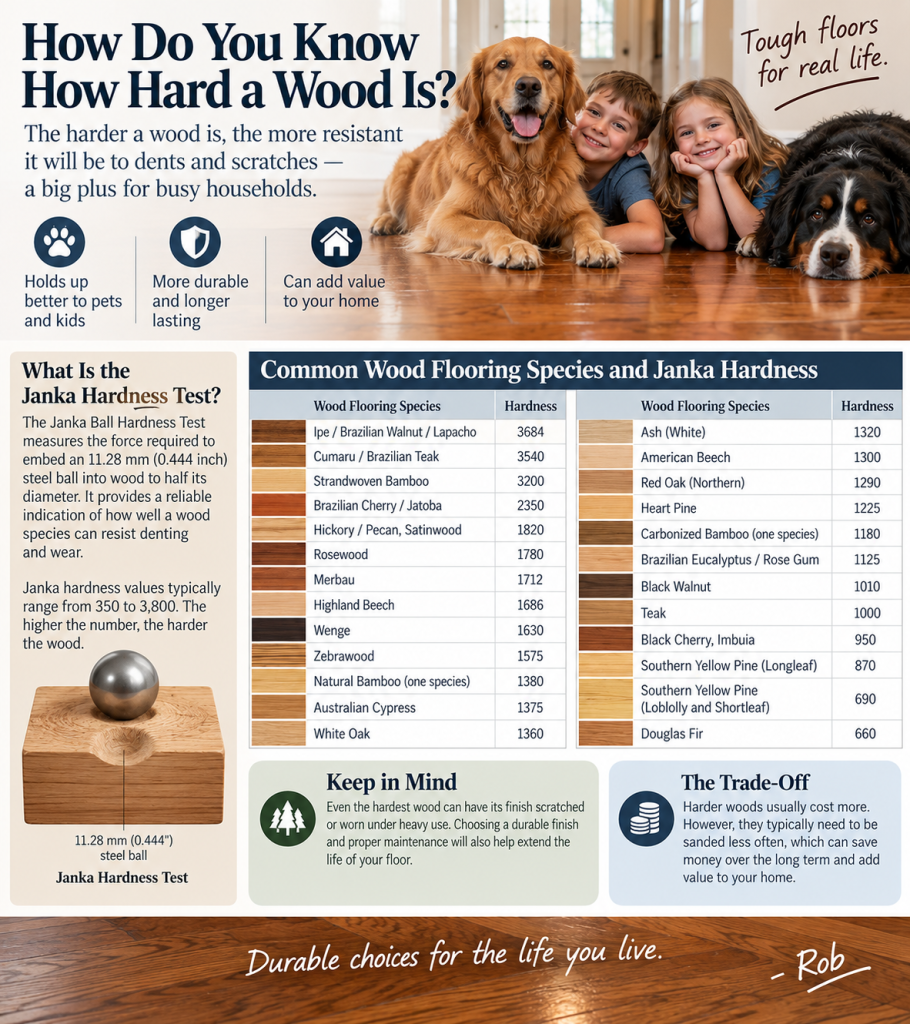
Wood hardness is calculated by using the Janka Ball Hardness Test. So, to determine how hard a wood is, all you have to do is look for the Janka Hardness of that species of wood.
The Janka Ball Hardness Test measures the force required to embed a 11.28 millimeter (0.444 inch) steel ball into wood to half its diameter. This method was chosen so that the result would leave an indentation 100 square millimeters in size. It is one of the best measures of the ability of a wood species to withstand denting and wear. It is also a good indicator of how hard a species is to saw or nail.
The Janka Ball Hardness Test ranks hardness in a range from about 350-3800. The most common hardwood used for flooring in the United States is Red Oak which has a relatively low hardness of 1250. The Janka ranking for Red Oak is 1290, whereas Brazilian Cherry has a Janka of 2350, which is nearly double that of Red Oak. That means that you can reasonably expect much more durability from Brazilian Cherry than from Red Oak. It’s important to not however, that no matter how hard the wood you choose is, the finish can still be scratched or worn under heavy use. Certain finishes are more durable and will also help extend the life of your floor, but that is a topic for another post.
Most importantly, harder floors can reduce long-term maintenance costs because they resist dents and wear better. As a result, the floor may need to be sanded and refinished less often. A softer (cheaper) floor may be less expensive up front, but it will need to be sanded more often, which shortens the life of the floor and costs much more long term.
Below you find a short list of common wood species and their hardness:
|
Wood Flooring Species |
Hardness |
| Ipe / Brazilian Walnut / Lapacho |
3684 |
| Cumaru / Brazilian Teak |
3540 |
| Strandwoven Bamboo |
3200 |
| Brazilian Cherry / Jatoba |
2350 |
| Hickory / Pecan, Satinwood |
1820 |
| Rosewood |
1780 |
| Merbau |
1712 |
| Highland Beech |
1686 |
| Wenge, Red Pine |
1630 |
| Zebrawood |
1575 |
| Natural Bamboo (represents one species) |
1380 |
| Australian Cypress |
1375 |
| White Oak |
1360 |
| Ash (White) |
1320 |
| American Beech |
1300 |
| Red Oak (Northern) |
1290 |
| Heart Pine |
1225 |
| Carbonized Bamboo (represents one species) |
1180 |
| Brazilian Eucalyptus / Rose Gum |
1125 |
| Black Walnut |
1010 |
| Teak |
1000 |
| Black Cherry, Imbuia |
950 |
| Southern Yellow Pine (Longleaf) |
870 |
| Southern Yellow Pine (Loblolly and Shortleaf) |
690 |
| Douglas Fir |
660 |
-Rob


Leave a Reply