
 Dear Rob: I want to stain my maple hardwood floor to match my stained maple kitchen cabinets, but my hardwood guy refuses, saying that the stain will not take. I know my kitchen cabinets are stained maple, so what gives? Why is he pulling my leg?
-Jared H. from Orem, Utah
Dear Jared:
Your installer is not really pulling your leg. He is actually trying to make sure you are happy with both your floor and his workmanship.
In my own flooring business, Natural Wood Floors, customers often asked me to stain maple and hickory floors during refinishing. I usually told them no. That answer often disappointed them, but there was a good reason.
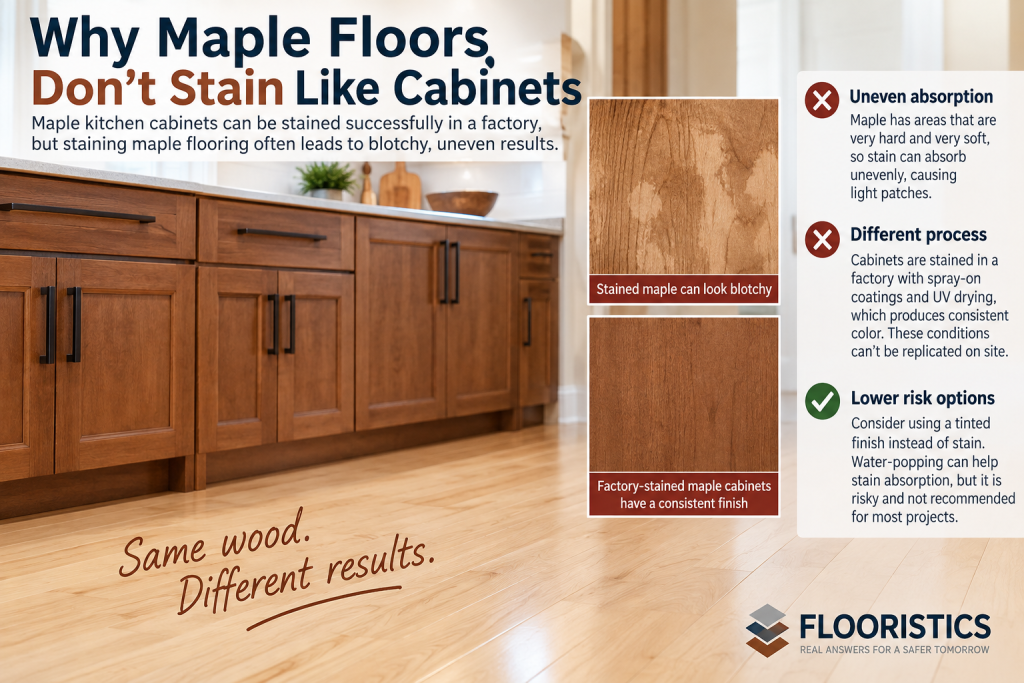
Maple and hickory can have very hard areas next to much softer areas. Those differences affect how the wood absorbs stain. The harder spots may absorb very little stain. As a result, the floor can develop light, blotchy patches.
Maple and hickory kitchen cabinets are different. Manufacturers usually stain them in a factory-controlled environment. They can use fast-drying, spray-applied coatings. They can also cure those coatings with UV lights. This helps create a more consistent color.
You cannot easily reproduce those conditions inside a home. The coatings used on site dry more slowly and behave differently during application.
This is what the Maple Flooring Manufacturers Association says about the subject:
“Due to the extremely tight cellular structure and variable grain patterns inherent in northern hard maple, the Maple Flooring Manufacturers Association (MFMA) does not recommend staining or bleaching maple strip flooring under any circumstances.
While small areas of individual flooring strips may accept stain without difficulty, it has been our experience that much of the maple surface will appear uneven and “blotchy” following the application of most stains or bleaching agents.
MFMA strongly suggests contacting your floor finish manufacturer directly for specific tinting product recommendations and application instructions.”
I think the risks are too high to move forward with staining maple or hickory. However, if you are really set on staining the floor, some highly skilled refinishers use a technique called water-popping.
With water-popping, the refinisher lightly dampens the floor with a sponge to open the wood grain. This can help the wood absorb the stain more evenly.
However, water-popping carries significant risks. Many less-experienced installers have not learned how to perform the technique properly, so I still do not recommend it.
-Rob
Leave a Reply