Flooristics, LLC

Article Search

Family Owned, Locally Operated
  • Home
  • Blog
    • Videos
    • Podcasts
    • Carpet and Rugs
    • Expert Witness
    • Floor Safety
    • Flooring Help
    • Hardwood and Laminate
    • Podcasts
    • Resilient
    • Tile and Stone
    • Tools
  • About
  • Contact
  • Floor Inspections
  • Expert Witness Services
  • Walkway Audits
    • Walkway Audit Process
    • OSHA “Qualified Person”

What is Hydrostatic Pressure?

January 9, 2017 by Flooristics staff 1 Comment

Share Button

When working with concrete, hydrostatic pressure plays a big role. But what is hydrostatic pressure?

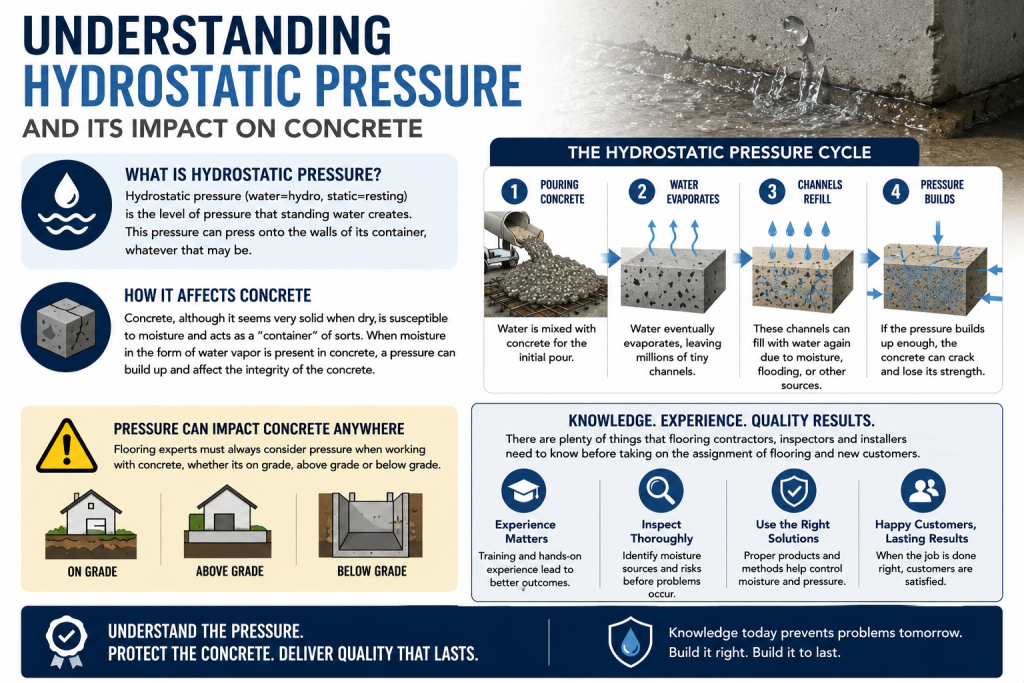
Hydrostatic pressure (water=hydro, static=resting) is the level of pressure that standing water creates. This pressure can press onto the walls of its container, whatever that may be. Concrete, although it seems very solid when dry, is susceptible to moisture and acts as a “container” of sorts. When water vapor is present inside concrete, pressure can begin to build. Over time, this pressure can affect the strength and integrity of the concrete.

During the initial pouring process, contractors mix concrete with water. As the concrete cures and dries, much of the water evaporates. This process leaves behind millions of tiny channels and pores inside the concrete.

Even after the concrete dries, these channels can fill with water again. Excess moisture, flooding, groundwater, or other sources can introduce moisture back into the concrete. As moisture builds inside these spaces, hydrostatic pressure can increase.

If the pressure builds up enough, the concrete can crack. Flooring experts must always consider pressure when working with concrete, whether it’s on grade, above grade, or below grade.

There are plenty of things that flooring contractors, inspectors, and installers need to know before taking on the assignment of flooring and new customers. When experience and training are present, the customers will be satisfied with a job well done. Without them, there will be plenty of room for customer complaints.


Filed Under: Floor Safety, Flooring Help, Hardwood and Laminate, Resilient, Tile and Stone, Tools Tagged With: concrete hydrostatic, hydrostatic, hydrostatic pressure, hydrostatic pressure concrete

Trackbacks

  1. Cement and Concrete: What's the Difference? - Flooristics, LLC says:
    April 27, 2026 at 11:51 am

    […] balance the ingredients to create a mixture and heat it into a fine mineral powder. Once workers mix the powder with water, it sets and forms a solid mass. It was first developed in Britain in the 1700s, and it quickly […]

    Reply

Leave a Reply Cancel reply

Your email address will not be published. Required fields are marked *

Call Today! 1.801.574.0387

  • Email
  • Facebook
  • Pinterest
  • RSS
  • Twitter
  • YouTube

Recent Posts

Trusting a South Dakota Slip and Fall Expert Witness

As part of a legal teams in South Dakota, you may be dealing with a liability lawsuit involving a … [Read More...]

How to Detect Urine in the Carpet

Wondering how to detect urine in the carpet? Whether it is from pets or toddlers, urine on the … [Read More...]

Recent Comments

  • Common Flooring Mistakes By Maintenance Workers - Flooristics, LLC on Certified Floor Inspections
  • How Can Moisture Problems in Concrete be Corrected? - Flooristics, LLC on Certified Floor Inspections
  • What Causes Crowning and Cupping in Wood Floors? - Flooristics, LLC on Certified Floor Inspections

Contact Us

Flooristics, LLC
P.O. Box 91171
Salt Lake City, UT 84109
801.574.0387

View our Financial Disclosure. and Privacy Policy.
© 2014 Flooristics, LLC. All rights reserved.