
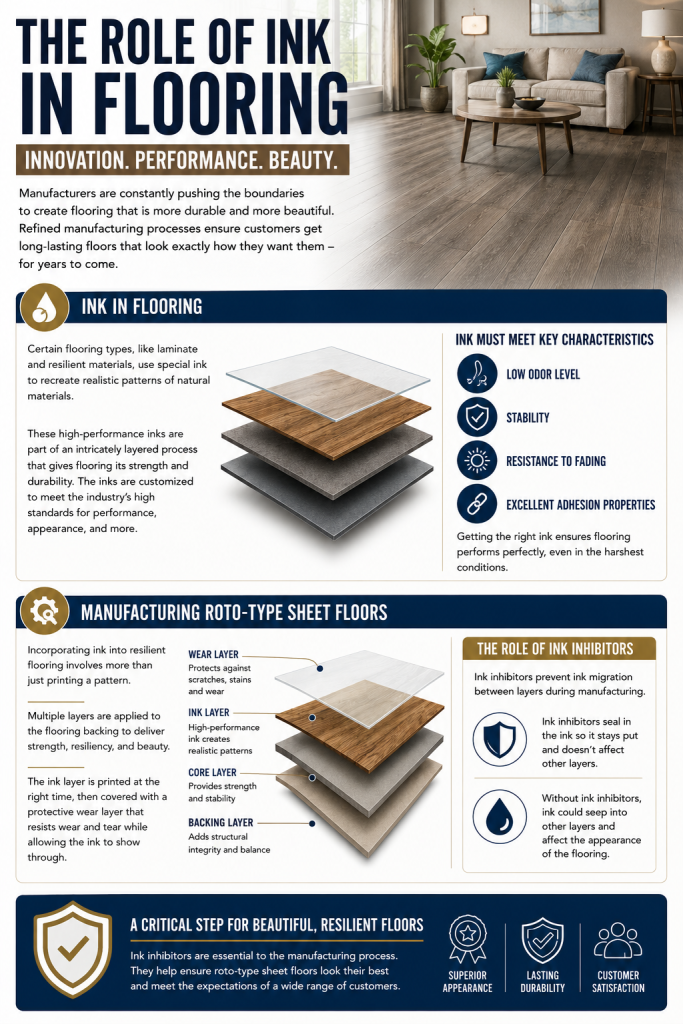
 Manufacturers are constantly pushing the boundaries in discovering ways to make their flooring products more durable and more beautiful. The manufacturing process is refined and perfected so that customers get a long-lasting type of flooring that looks exactly how they want it for years to come.
Ink in Flooring
The ink used in flooring material must meet several characteristics. Some of these characteristics include a low odor level, stability, resistance to fading, and excellent adhesion properties. Manufacturers consider it very important to get the right ink so that their flooring will perform perfectly under even the harshest conditions.
Manufacturing Roto-Type Sheet Floors
Manufacturers do much more than simply print ink onto resilient flooring materials. They build resilient flooring with multiple layers that provide strength, resiliency, durability, and appearance.
Manufacturers apply these layers to the flooring backing in a specific sequence during production. At the proper stage of the manufacturing process, they print the ink layer onto the material. They then cover the printed layer with a protective wear layer that resists scratches, stains, and everyday wear while still allowing the printed design to remain visible.
To prevent ink migration between the different layers during manufacturing, ink inhibitors are used. The ink inhibitors help seal in the ink so that it stays put and doesn’t affect the other layers. Without ink inhibitors, the ink could seep into the other layers and affect the appearance of the flooring.
Manufacturers of roto-type sheet floors should definitely not overlook this important step in the manufacturing process. Ink inhibitors are a critical part of getting resilient flooring to look its best and satisfy a wide range of customers.

[…] have to do with cleaning and maintenance. When the flooring is not being properly cared for, it can cause a lot of problems, both with appearance and performance. Customers need to be educated on how to properly clean and […]