
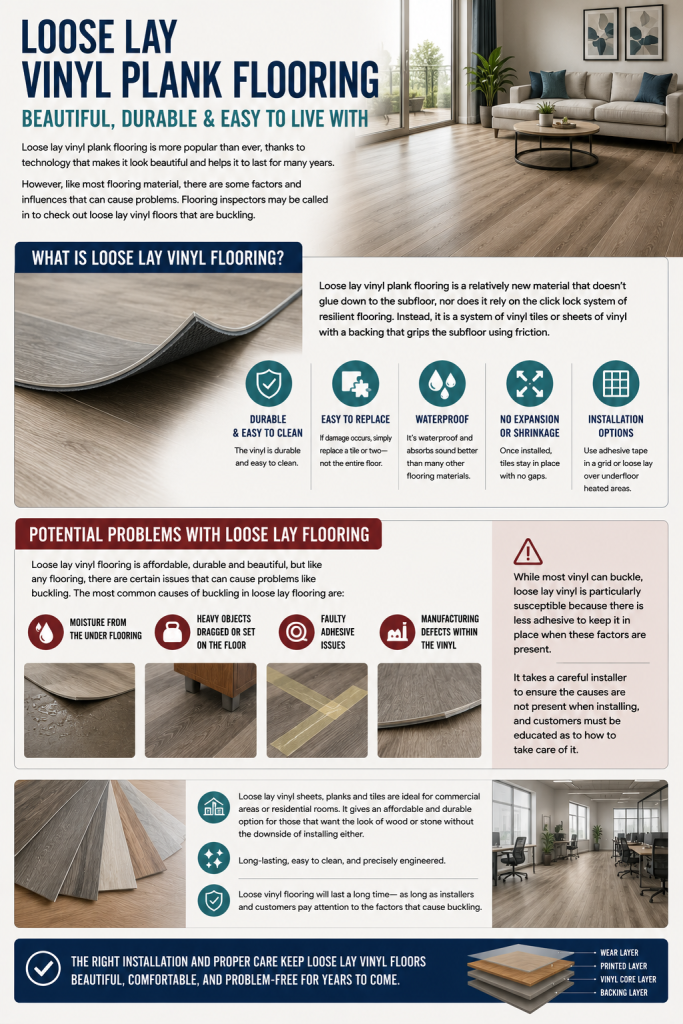
 Loose lay vinyl plank flooring is more popular than ever, thanks to technology that makes it look beautiful and helps it to last for many years. However, like most flooring materials, there are some factors and influences that can cause problems. Flooring inspectors may be called in to check out loose-lay vinyl floors that are buckling.
What is Loose-Lay Vinyl Flooring?
Loose-lay vinyl plank flooring is a relatively new flooring material. It does not glue down to the subfloor. It also does not rely on the click-lock system commonly used with other resilient flooring products.
Instead, loose-lay flooring uses vinyl tiles or sheets with a special backing. The backing grips the subfloor through friction and helps keep the flooring in place.
The vinyl is durable and easy to clean. In the event of damage to vinyl tile floors, it’s easy to replace a tile or two instead of replacing an entire floor of other material. It’s also waterproof and absorbs sound better than many other flooring materials.
Vinyl tiles and sheets are not subject to expansion or shrinkage, so once the tiles are in place, there are no gaps. In larger areas, many installers find that strips of adhesive tape set in a grid help secure the loose lay vinyl sheet or tile. Both options are excellent for installing over underfloor heated areas.
Potential Problems
Loose lay vinyl flooring is affordable, durable, and beautiful, but like any flooring, there are certain issues that can cause problems like buckling. The most common causes of buckling in loose lay flooring are:
- Moisture from the underflooring
- Heavy objects dragged or set on the floor
- Faulty adhesive issues
- Manufacturing defects within the vinyl
While most vinyl is subject to buckling, loose lay vinyl is particularly susceptible because there is less adhesive to keep it in place when the above factors are present. It takes a careful installer to ensure the causes are not present when installing, and customers must be educated as to how to take care of them.
Loose lay vinyl sheets, planks, and tiles are ideal for commercial areas or residential rooms. Loose-lay vinyl flooring gives customers an affordable and durable option. Many people choose it because it can imitate the appearance of wood or stone without the challenges associated with installing those materials.
I found it interesting how you mentioned how moisture under the vinyl flooring can cause damage and buckling. My wife and I want to install vinyl flooring in our new home for the water-resistant benefits it has but we have been unsure of how we are going to take care of it. I will be sure to pass this on to her so we can have our vinyl flooring last as long as it can!
Don’t always believe the marketing hype. In my experience, water is one of the top causes of floor failures across all categories of floor coverings.
If Drop-In Loose Lay Luxury Vinyl gets wet & buckles from ground water coming up on a concrete basement floor, can it be pulled up, dried and then replaced??
It depends on what the core of the flooring is made out of.
My house was built in 1945 and has a crawl space. From the advertisement on the Armstrong Flooring website, the loose lay sheet vinyl with heavy gauge fiberglass backing, it seemed like the best product. I had it installed in kitchen, dining room, and bathroom. The first winter (Oklahoma) my beautiful floors had big long bubbles in them. When I messaged Armstrong, they told me I might want to glue it down. If I had known this, I may have opted for a different covering all together as everyone assured me I didn’t need to use glue at all. I have a subfloor and a tongue and groove floor on top of that. I thought about insulating between the floor joists to see if that helps. Any help or suggestions would be fantastic!
Your vinyl flooring is likely trapping moisture from the crawlspace. I suggest that you have an inspector take a look at how you can mitigate the moisture in the crawlspace.