
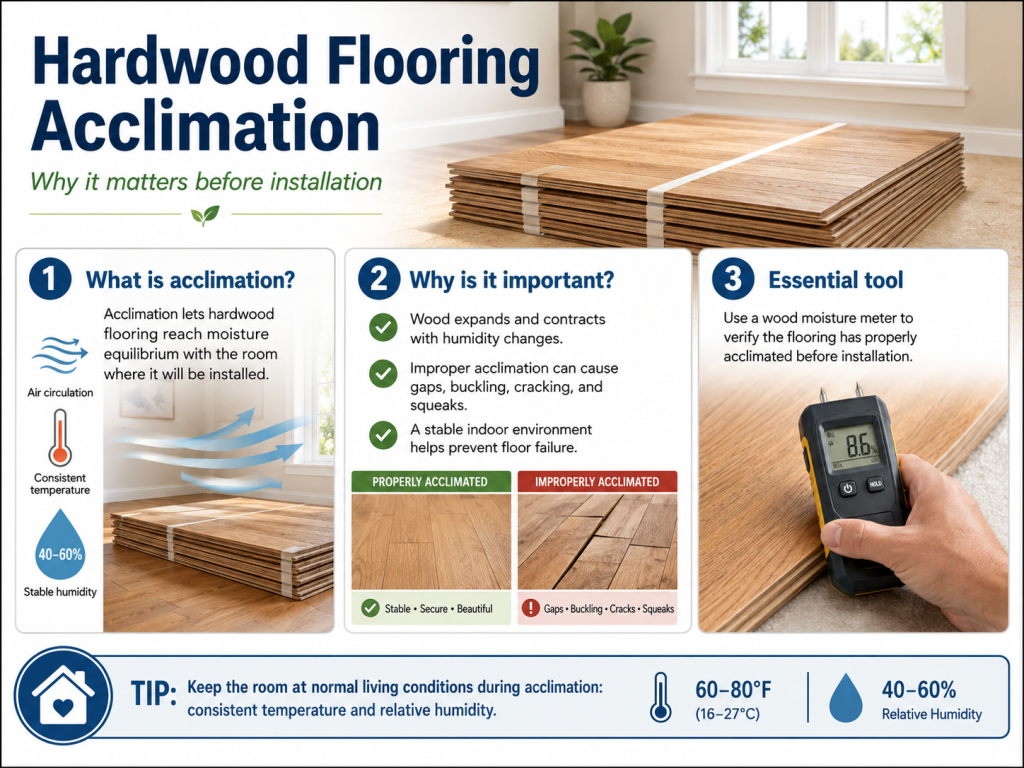
 When planning your hardwood flooring project, it is important to make sure that you allow enough time for the wood flooring to properly acclimate in the space prior to the installation. Hardwood flooring expands and contracts based on relative humidity (RH). As a certified wood flooring inspector (CWFI), I commonly see floor failures due to installers not acclimating the flooring before installation, either because they are cutting corners or giving in to customer demands for completion dates. That is really unfortunate, as it is an easily preventable problem.
What is hardwood flooring acclimation?
Acclimation is the process of bringing the moisture content (MC) of hardwood flooring into balance with the space where it will be installed. The flooring should sit in the installation area before work begins. During this time, keep the building or home at its normal temperature and humidity levels. For example, if you normally keep the space at 70 degrees with a whole-house humidifier running, maintain those conditions while the wood acclimates.
Why is hardwood flooring acclimation important?
Hardwood flooring shrinks and contracts based on humidity levels. When temperature and humidity change, wood moves. In general, wood is most dimensionally stable at around 30% MC. When it’s below or above that, it can fail, causing gaps between boards or buckling and cracking of the boards. Movement of the boards during expansion and contraction can also cause fasteners to loosen, resulting in squeaks.
Essential tools for hardwood flooring acclimation.
The only real way to tell if wood is properly acclimated is to use a moisture meter. Delmhorst makes a nice digital wood moisture meter


Leave a Reply